Timing Belt Service
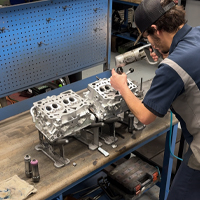
The most critical scheduled replacement on an EJ-engine Subaru. We've rebuilt the engines from belts that let go — we'd rather do yours before it does.
Belt or Chain?
Not every Subaru needs timing belt service. EJ-series engines use a rubber belt with a mandatory replacement interval. FA-series engines use a timing chain — no scheduled replacement required. If you're not sure which you have, we can tell you in 30 seconds with your VIN.
Timing Belt — Requires Replacement
EJ20, EJ25, EJ207, EJ257 engines — WRX (2002–2014), STI (all years), Forester (up to 2012), Legacy & Outback (up to 2012), Baja, Impreza (up to 2011)
Timing Chain — No Belt Service Needed
FA20, FA24 engines — WRX (2015+), BRZ / 86, Forester (2013+), Legacy & Outback (2013+), Crosstrek, Impreza (2012+)
Not sure? Call us at (530) 823-7645 or send us your VIN — we'll confirm your engine in seconds.
Everything That Needs
to Come Out Comes Out Right
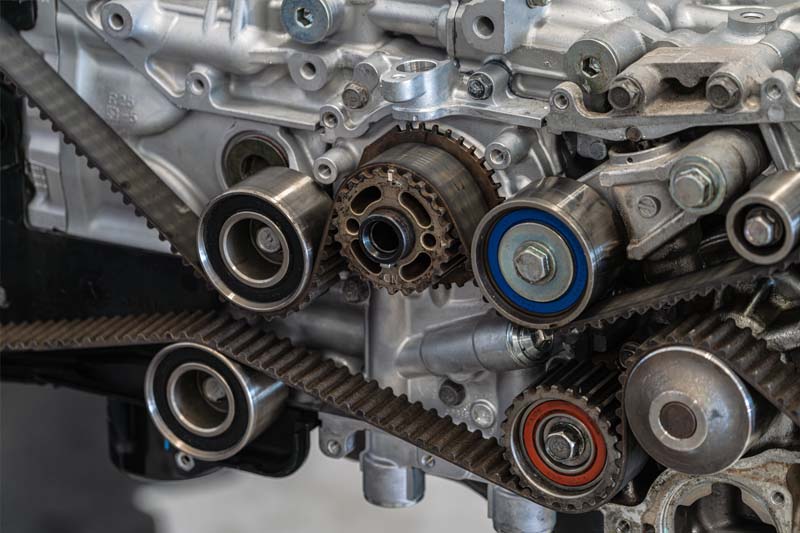
Accessing the timing belt on a Subaru EJ engine requires removing substantial hardware from the front of the engine. Once we're in there, replacing every component that will need attention before your next belt interval is the only sensible approach — so you're not paying full labor a second time in 20,000 miles.
- Timing belt — OEM Subaru or Gates OEM-equivalent
- Hydraulic tensioner — new, not adjusted
- Idler pulleys — replaced as a set
- Water pump — replaced while the engine is open
- Camshaft and crankshaft seals — no worn seals left behind
- Accessory drive belts — replaced at the same time
- Thermostat — replaced while the cooling system is open
- Coolant flush — fresh coolant after water pump replacement
- Full multi-point inspection on completion
Why replace everything at once?
-
The labor is the cost
Getting to the timing belt requires tearing down the front of the engine. That labor is the same whether you replace one component or all of them. Parts are cheap compared to a second round of disassembly — do everything now.
-
Water pump failure is unpredictable
EJ water pumps fail without warning. If yours goes at 20k miles after a belt-only service, you're paying full disassembly labor again. A new water pump at belt time is inexpensive — it's the access that costs money. Replace it while you're in there or risk paying the same labor twice.
-
EJ engines are interference engines
When the belt snaps, the pistons and valves collide at engine speed. That's bent valves, damaged pistons, and a complete engine rebuild. The timing belt service costs a fraction of what that repair runs. There is no cheaper insurance for an EJ Subaru.
We've Rebuilt the Engines
From Belts That Let Go
In-House Machine Shop
If the timing belt inspection reveals anything that needs machine work — head resurfacing, valve seating, worn cam journals — we handle it in-house. No outsourcing, no waiting on a third-party shop, no markup. One shop, start to finish.
ASE Certified, EJ-Specific
Our ASE Certified Master Technicians have performed this service on hundreds of EJ-series engines. They know the torque specs, the proper tensioner procedure, the difference between EJ20 and EJ257 front covers, and the failure points that show up if it isn't done right.
2-Year Warranty
Every component of the service — belt, water pump, tensioner, seals — is covered by our 2-year warranty. We use quality parts and we stand fully behind them. If anything we installed fails within that window, we make it right.
Timing Belt FAQ
When should I replace the timing belt on my Subaru?
Subaru's factory interval for EJ-series engines is 105,000 miles or 8 years — whichever comes first. The time limit is real: a belt that's never seen hard use can still crack and degrade from age alone. If you've purchased a used Subaru without service records, treat the belt as overdue and have it inspected immediately. The cost of confirming it's fine is nothing compared to what happens if it isn't.
Can I just replace the belt and skip the water pump?
Technically yes. We strongly advise against it. The water pump is accessible only when the timing belt is removed — it's right there. The part itself is inexpensive compared to the labor required to reach it. If the pump fails before your next belt interval, you're paying full disassembly labor again to access it. Worse, a water pump failure on an EJ engine causes rapid overheating, which leads to head gasket failure. It is not a risk worth taking.
What happens if the timing belt breaks?
EJ-series Subaru engines are interference engines, meaning the pistons and valves share the same space at different times — coordinated by the timing belt. When the belt snaps, that coordination fails and they collide at engine speed. The result is bent valves, damaged pistons, and typically a destroyed engine. This is not something that can be fixed cheaply — it typically means a complete engine rebuild. The timing belt service costs a fraction of that.
How much does timing belt service cost at M45?
Pricing varies by model, engine variant, and which components you're replacing alongside the belt. A comprehensive service covers the belt, water pump, tensioner, idler pulleys, and seals. Call us at (530) 823-7645 or schedule a consult and we'll give you a firm quote for your specific car.
How long does the service take?
A complete timing belt service typically takes 4–6 hours. Plan to leave the car for the day. Loaner vehicles are available — just mention it when you schedule and we'll have one ready so your day isn't on hold.